
The Mood Tracking Journal: How Paying Attention to Your Emotional Patterns Changes Everything
For a long time I knew my moods were shifting, but I couldn't tell you why. Some weeks felt light and easy. Others felt heavy for no clear reason. I'd chalk it up to stress, or sleep, or the season, or whatever was closest at hand. But I never actually looked.
When I started tracking my mood every day, something changed. Not because the data was magical, but because the act of pausing, even for thirty seconds, and naming how I felt started to surface things I had been glossing over. Patterns I didn't know existed. Triggers I had been ignoring for months. And on the hardest days, a quiet reminder that things had been better before and would be again.
This is what mood tracking actually is. Not a productivity trick. Not a therapy replacement. Just a small, consistent practice that helps you understand yourself a little more clearly each month.
Why Track Your Mood at All
Most of us operate on autopilot when it comes to emotions. We feel things, we react to them, and then we move on. We rarely stop to notice what triggered a low day or what made a great week so good. A mood tracking journal changes that by creating a record. It turns the invisible visible.
Over time, you start to see things like:
- Certain days of the week tend to hit harder than others
- Your mood drops in the afternoon when you skip lunch or skip movement
- Social time leaves you energized or depleted depending on which kind
- Sleep quality has a bigger effect than you ever gave it credit for
- Some tasks restore you, others drain you, even when they look similar from the outside
None of this is groundbreaking on its own. But when you have weeks or months of your own data, it stops being theory and becomes personal fact. That shift, from "I think stress affects my mood" to "I can see that every time I have a run of back-to-back calls, I feel flat by Thursday," is genuinely useful. It gives you something to work with.
The other thing that consistent tracking does is give you language for how you're feeling. That alone can reduce the overwhelm of a hard day. Naming an emotion, even just choosing one word for it, takes some of its weight away. You stop being swallowed by a feeling and start being someone who is observing it.
Mood Tracking vs Journaling: They Work Better Together
People sometimes treat mood tracking and journaling as the same thing, or as alternatives. They're really not.
Mood tracking is structured. You're logging a rating, a word, maybe a few tags. It's fast. It's consistent. And that consistency is what makes the data meaningful over time. If you only log your mood when you feel inspired to, you won't have enough of a record to see patterns. The habit has to be daily, or close to it.
Journaling is something else. It's where you process, reflect, and make sense of what's happening beneath the surface. A journal entry might start with "I felt really irritable today" and end with "I think I've been avoiding a difficult conversation and it's been sitting in my chest all week." You can't get there with a one-to-five rating scale. You need words and space and a little time.
When you use both, they reinforce each other. The mood log catches the patterns. The journal helps you understand them. They do different jobs, and both jobs matter.
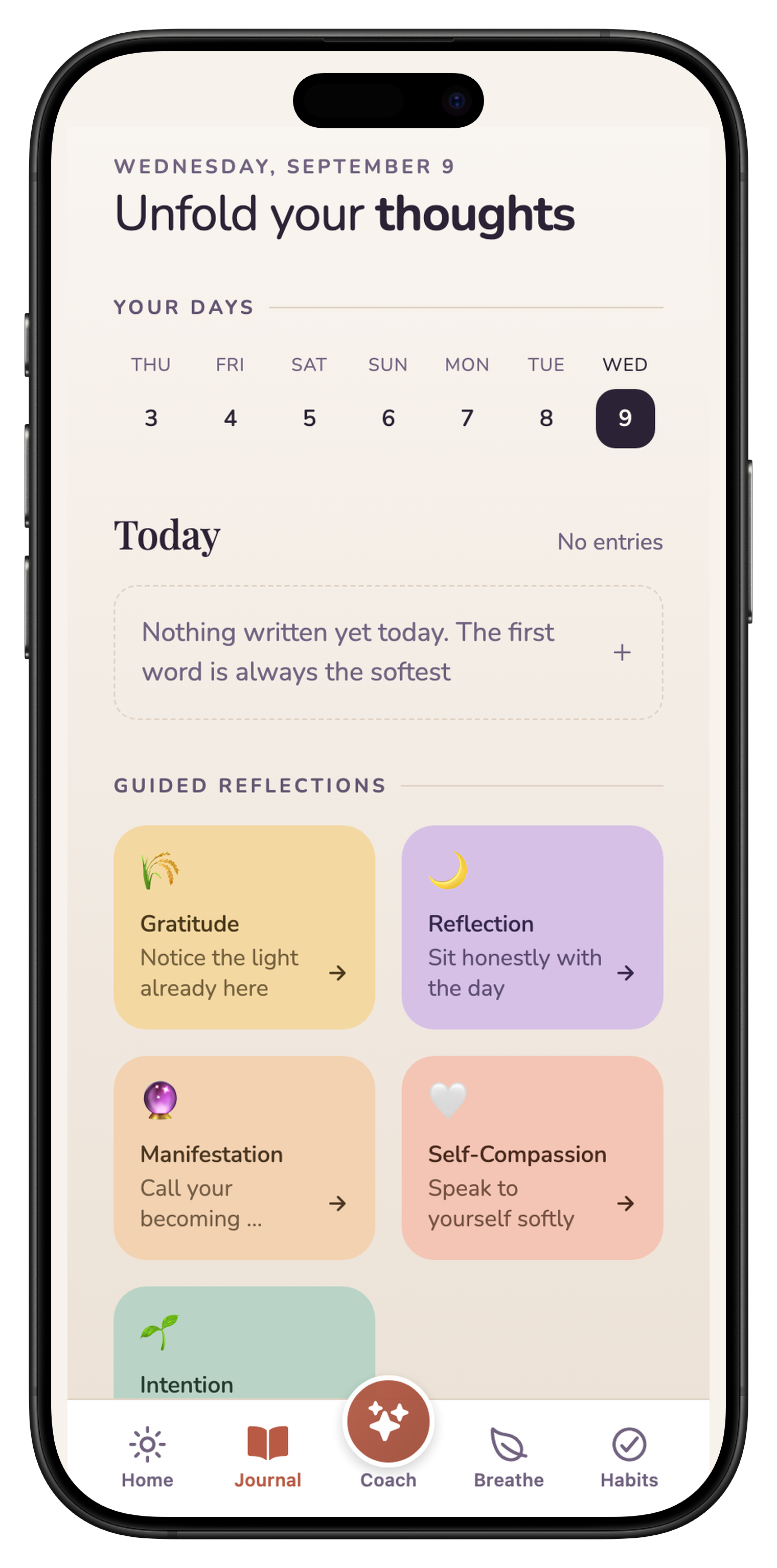
In Wellevate, the mood tracker and the journal live in the same space on purpose. You can log your mood with a single tap, then drop into a journal entry right below it. Some days you'll just log and go. Other days you'll write a full page. The app doesn't push you toward one or the other. It just holds both for you.
What Is a Year in Pixels (and Why It Actually Works)
One of the things people ask about most in Wellevate is the Year in Pixels. If you haven't come across it, the idea is simple: each day of the year gets a small colored tile based on how you rated your mood. Over time, these tiles build into a visual mosaic of your year.
By month three or four, you can look at it and see things that would never have surfaced otherwise. A string of muted tiles in February. A bright stretch in late summer. A rough patch in October that you barely remember now but clearly felt at the time. The mosaic doesn't analyze anything. It just shows you what was there.
There's something about seeing your emotional life rendered visually that makes it real in a way that numbers don't. Numbers are easy to rationalize. A colored grid of 365 days is harder to argue with.
"I looked at my Year in Pixels after nine months and felt something I didn't expect: compassion for myself. I could see the rough patches. I could also see that I got through every single one of them."
The pixel view is also motivating in a quiet, low-pressure way. Not in a streak-obsessed, don't-break-the-chain way. More like, you start to want the full picture. You don't want to leave a blank. And so you log. Even on hard days. Especially on hard days. Because hard days are part of the record too, and they deserve to be counted.
How to Build a Mood-Tracking Habit That Lasts
This is where most people run into trouble. Not with wanting to track their mood, but with keeping the habit going past the first couple of weeks. Here's what actually helps.
Start smaller than you think you need to
If you're deciding between a one-word mood log and a detailed emotional inventory, start with the one word. You can always add more later. But if the habit requires real effort or decision-making every time, it won't survive a tired Wednesday evening. A check-in that takes under a minute is one you'll actually do. Build the consistency first. Everything else can come after.
Tie it to something you already do
Habit stacking is genuinely one of the more useful ideas in behavior change research. The easiest time to log your mood is right after something you already do every day without thinking: morning coffee, brushing your teeth, getting into bed. You don't need a separate mood-tracking ritual. You need thirty seconds attached to something that already happens. Set a reminder for that exact moment and it becomes nearly automatic.
Let go of the idea of grading yourself
This one takes a little time to internalize. The goal of a mood tracking journal is not to have more good days than bad ones. The goal is to understand yourself better. A string of low-mood days isn't failure. It's information. What was happening that week? What did you need? What were you getting or not getting? When you approach the log as someone collecting data rather than someone judging a performance, the practice becomes sustainable.
Let the app carry the overhead
One of the reasons Wellevate exists is to take the friction out of this kind of daily practice. Gentle reminders at the time you choose, a check-in that doesn't require you to be eloquent or reflective on demand, and a log that keeps building quietly without you having to organize or manage it. The less effortful it is to maintain, the more likely you are to stay with it long enough to see something real.
Turning Mood Data Into Real Insight
After a month or two of consistent tracking, the data starts to get interesting in a different way. You're not just logging how you feel. You're building a picture. And that picture can start to answer questions you've been carrying for years.
Why do I always feel restless on Sunday evenings? Why does talking to certain people leave me flat for the rest of the day? Why did last fall feel so heavy when nothing was technically wrong in my life?
The answers are usually in the log, waiting to be noticed.
Wellevate surfaces patterns in your mood data over time, so you don't have to go back and manually tally your good days versus your low ones. But even the raw visual of the Year in Pixels tells a story once you have enough of it. You'll start noticing things. Seasons that consistently feel harder. Weeks where your mood tracks closely with how much sleep you got. Days where you moved your body and what that looked like in the record afterward.
This is what separates a mood tracker from a simple mood diary. A diary captures moments as they happen. A tracker reveals the structure underneath them. And when you pair that structure with your journal entries, something more useful becomes possible: you can go back to a low-mood stretch, read what you wrote, and trace the actual cause and effect. That is the kind of self-knowledge that starts to change how you make decisions and take care of yourself.
It also changes how you think about the future. If you know, from your own data, that certain conditions tend to bring your mood down, you can build around them. Not to avoid difficulty, but to meet it with a little more preparation. That's the real value of the practice.
If you're curious about how mood tracking fits alongside other parts of a wellness routine, the piece on journaling and manifestation covers how these tools can work together without feeling like a lot to manage.
A Note on Starting Before You Feel Ready
There's a version of this where you wait until you have the right journal, or the right app, or a morning routine already in place, or some quieter period in your life to begin. That period rarely comes. The practice doesn't need ideal conditions. It needs a first entry.
You don't need to be a data person to benefit from tracking your mood. You don't need to have it figured out or know what you're looking for yet. The practice of noticing, naming, and recording how you feel is enough to start. Over time, you'll learn things about yourself that no one else could tell you, because no one else has been paying this kind of attention.
Wellevate was built for exactly this kind of quiet, consistent self-knowledge. Not through endless features or metrics that make you feel behind. Just a calm, daily practice that accumulates into something real over months and years. The mosaic fills in one tile at a time.
Start your mood tracking journal today
Log your first mood, begin your Year in Pixels, and build the kind of self-awareness that actually sticks. It takes less than a minute a day.
Start free →