Breathwork for anxiety: how to calm your body in minutes
You know the feeling before you can name it. Your chest gets tight. Your thoughts start sprinting. Maybe your hands go cold or your jaw clenches. By the time your mind catches up and labels it anxiety, your body has already been in it for a while. The frustrating part is that thinking your way out rarely works. You cannot reason with a racing heart.
But there is one door into the nervous system that is always unlocked, and it is your breath. Slow, deliberate breathing is the fastest, most portable way to tell an anxious body that it is safe. No app required to start, though a guided one makes it far easier to keep going.
Why breathwork works on anxiety
Anxiety is largely a physical state. When your brain senses threat, real or imagined, it flips your body into fight or flight through the sympathetic nervous system. Heart rate climbs, breathing goes shallow and quick, muscles tense. This is useful if you are actually in danger. It is exhausting when the danger is a looming email.
Here is the leverage point. That stress response runs mostly on autopilot, but breathing is the one part of it you can consciously control. When you slow your exhale in particular, you gently activate the parasympathetic nervous system, the rest and digest side. Your body reads a long, calm exhale as a signal that the threat has passed. Heart rate settles. Shoulders drop. The spiral loses its fuel.
You cannot argue a panicked mind into calm. But you can breathe a panicked body into it, and the mind follows.
Three breathwork techniques for anxiety
You do not need anything fancy to begin. These three are simple, evidence-informed, and work almost anywhere.
1. The extended exhale
This is the simplest and often the most effective. Breathe in through your nose for a count of four, then breathe out slowly through your mouth for a count of six or eight. The exhale being longer than the inhale is the whole trick. Do this for even ten breaths and you will usually feel your body downshift.
2. Box breathing
Popular with people in high-pressure jobs for a reason. Breathe in for four, hold for four, breathe out for four, hold for four. The even, square rhythm gives a busy mind something steady to hold onto, which is part of why it calms so reliably.
3. Physiological sigh
Take a normal breath in through your nose, then a second small sip of air on top to fully inflate your lungs, then a long slow exhale through your mouth. Two or three of these in a row can take the edge off a sharp spike of anxiety in under a minute.
- In a meeting: the extended exhale, done quietly, calms you without anyone noticing.
- Before sleep: box breathing settles a racing bedtime mind.
- Mid panic: the physiological sigh acts fast when you need relief now.
Why a guided practice beats going it alone
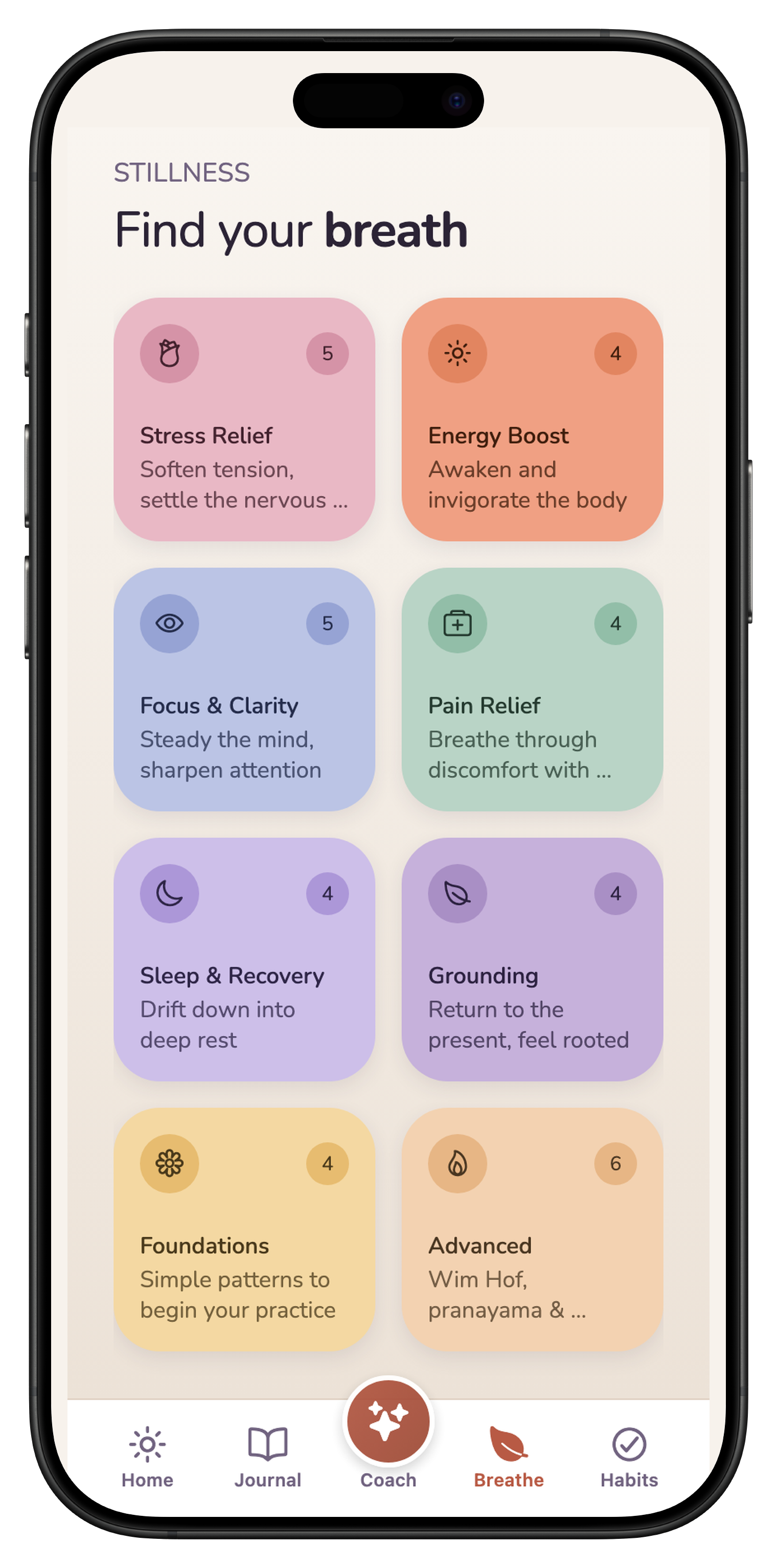
Knowing these techniques and actually using them in the moment are two different things. When anxiety is high, counting your own breath is hard, and it is easy to speed up without realizing. That is exactly where a guided session helps. In Wellevate, breathwork sessions give you an animated orb that expands and contracts at the right pace, so you simply follow the shape instead of managing the counting yourself. Your only job is to breathe with it.
Wellevate includes guided sessions built for specific states, stress, sleep, focus, and grounding, along with healing frequency soundscapes that make it easier to settle. Because the sessions are short, usually three to five minutes, they fit into a real day. You can take one between meetings, in a parked car, or lying in bed when your mind will not switch off.
Turning it into a habit that lasts
The people who get the most from breathwork are not the ones who do a perfect hour once. They are the ones who do three minutes often. The goal is to make the practice so small and so easy to reach that you actually use it when it counts.
This is the whole idea behind how Wellevate works. One small ritual a day, no guilt for the days you miss. Over time, breathwork stops being an emergency tool you forget you have and becomes a reflex your body reaches for on its own. Pair it with a daily mood check-in and you also start to see which situations spike your anxiety in the first place, which is where lasting change begins. If that interests you, our piece on mood tracking and journaling goes deeper.
A gentle note
Breathwork is a genuinely powerful tool for everyday anxiety and stress, and for many people it is enough to change their days. It is not a replacement for professional care. If anxiety is disrupting your life, please reach out to a doctor or therapist. Breathwork can sit alongside that support beautifully, not instead of it.
The next calm breath is one tap away.
Try a guided breathwork session in Wellevate, free. No account needed to begin.
Start free →