
The Best Manifestation App of 2026: What Actually Makes One Worth Using
You've probably downloaded at least one manifestation or affirmation app and quietly stopped using it within two weeks. Not because the idea didn't resonate, but because the app itself felt hollow. Affirmations that sounded like they were written by a Fortune cookie. Reminders that piled up like unanswered emails. A "journal" that was really just a notes field with no structure to pull out what mattered.
I've been there. Most people who care about this kind of inner work have. The real question isn't whether manifestation practices help (for a lot of people, they genuinely do, and we'll get into why). The question is what kind of app actually supports the practice instead of replacing it with something that feels like content consumption.
What makes a good manifestation app
The apps that stick are rarely the ones with the most features. They're the ones that make showing up feel natural. A few things separate the useful from the forgettable:
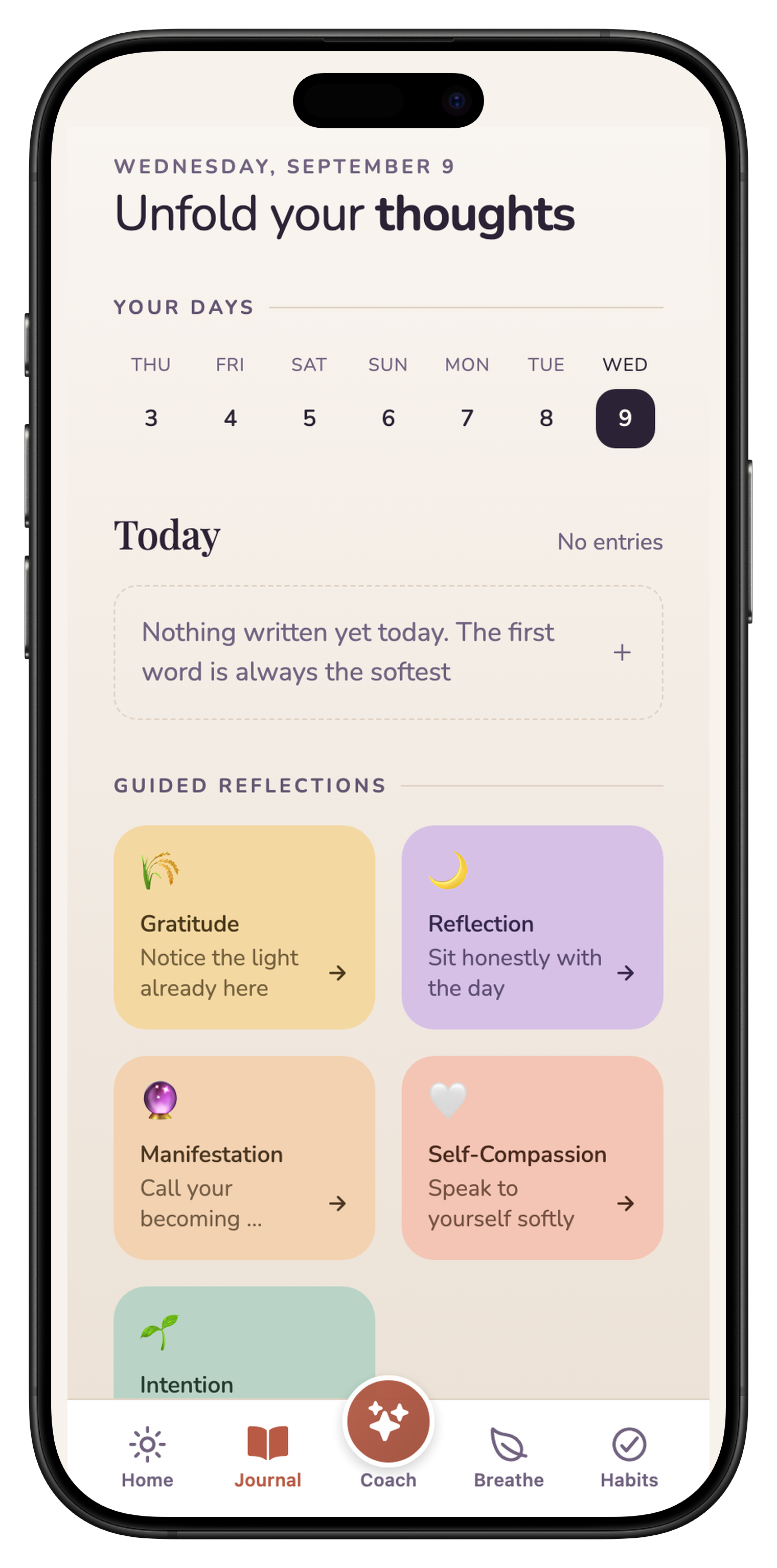
- A place to write your intentions in your own words. Preset affirmations you didn't write rarely land the same way. The best manifestation journal apps give you structure without putting words in your mouth.
- Daily prompts that evolve with you. If you're answering the same three questions every morning for six months, the practice goes stale. You want something that nudges you in slightly different directions as your goals shift.
- Mood and emotional tracking alongside intentions. Manifestation without self-awareness is wishful thinking. Knowing how you actually feel day to day is what connects your written intentions to real patterns in your life.
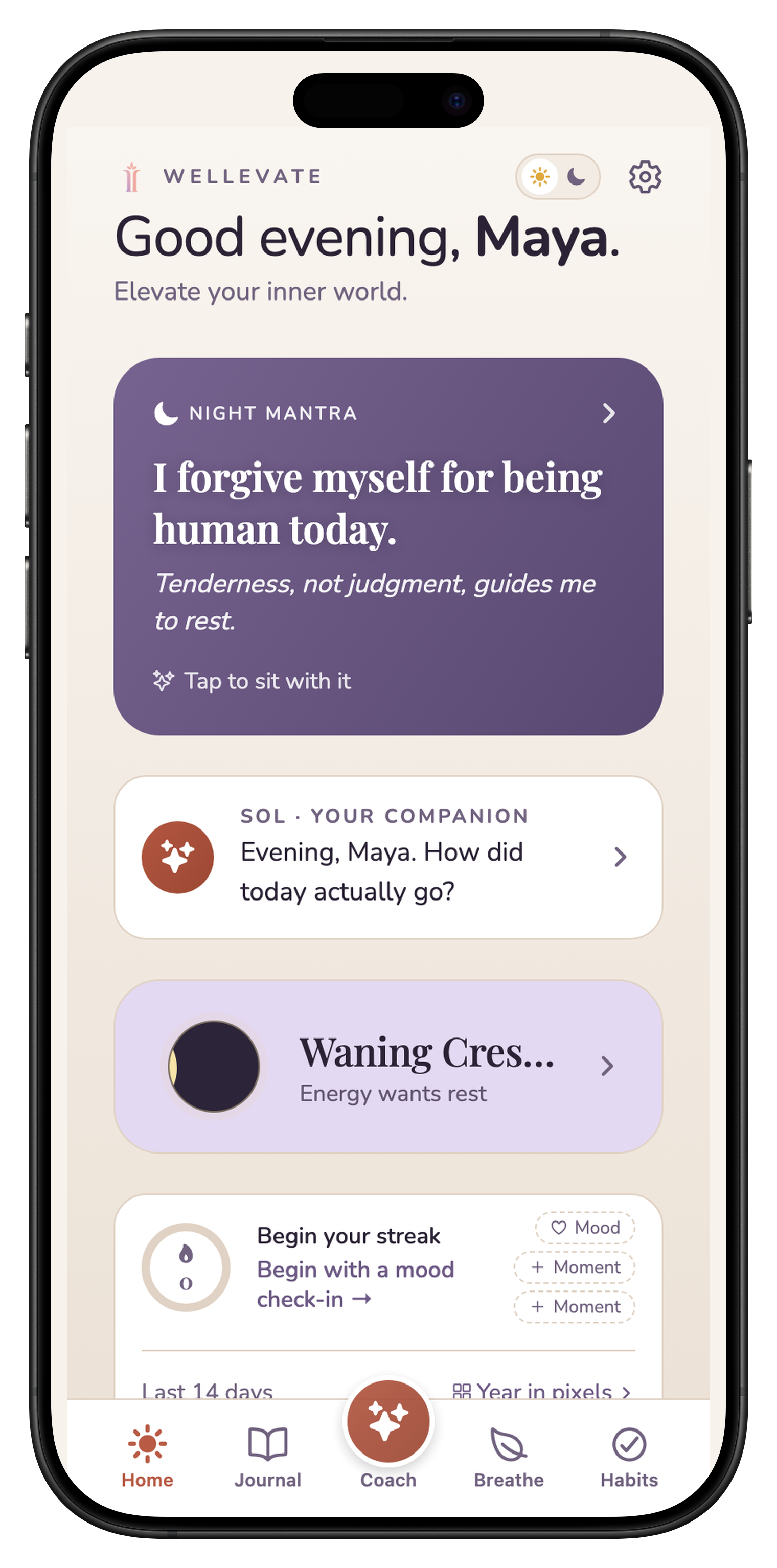
- A design that feels calming, not stimulating. This sounds like a small thing until you've opened a wellness app and been greeted by gamification badges, streak pressure, and a feed of strangers' content. A good manifestation app should feel like opening a journal, not a social platform.
- Gentle accountability, not guilt mechanics. Streaks that shame you when you miss a day work against the whole point of building a sustainable inner practice.
Wellevate was built around exactly these principles. The how it works page walks through the full approach, but the short version is that it pairs guided manifestation journaling with mood tracking and an AI coach named Sol, all inside a visual environment that's genuinely pleasant to sit with.
Manifestation journaling vs. affirmation apps: are they the same thing?
People search for both, but they're asking slightly different things. Most daily affirmation apps are push-notification-first: they deliver a line or two to your lock screen and call it a day. That's not nothing, but it's surface-level. A manifestation journal app asks more of you, in a good way. You're writing. Reflecting. Tracking how your intentions are showing up (or not) in your actual life.
The distinction matters when you're choosing what to use. If you want a gentle nudge each morning, an affirmation app might be enough. If you want to actually notice change over time, you need somewhere to write things down and return to them. Journaling is where the practice gets traction.
The best setups do both: a short daily affirmation or intention-setting moment, paired with a structured space to reflect. That's the model Wellevate uses.
"The journal entries I wrote six months ago tell me more about where I was than any mood tracker could. But the mood tracker tells me if I'm actually moving. You need both."
Does manifestation actually work?
This is the question that hovers over any honest discussion of this topic, so let's take it seriously.
The evidence for "the universe delivers what you ask for" is thin. But that framing misses what's actually useful about manifestation practices. When you write down a specific intention and return to it regularly, a few things happen that are well-supported by psychology and behavioral science:
- You get clearer on what you actually want, which matters more than people think. Most people have a vague sense of wanting things to be different without specificity about what "different" looks like.
- Your attention shifts. When you write "I want to find work that feels meaningful," you start noticing relevant conversations, job listings, and people that you previously scrolled past.
- You build the habit of reflection, which in itself tends to improve decision-making and reduce reactive behavior over time.
None of that requires believing in anything mystical. It just requires consistency. Which is why the app you choose matters more than people give it credit for. A practice that you actually return to will always outperform a perfect theoretical system you abandon after two weeks.
How to actually stick with a daily manifestation practice
The friction point for most people isn't motivation. It's that the practice doesn't fit anywhere in their actual day. A few things that genuinely help:
Attach it to something you already do
Morning coffee. The few minutes before you open email. After you brush your teeth at night. Manifestation journaling doesn't require a 45-minute window. Five minutes of focused intention-setting, done consistently, is worth more than an hour-long Sunday session you do twice a month.
Keep your intentions specific and in your own voice
Generic affirmations ("I am abundant and worthy") can feel true in the moment and meaningless by afternoon. Something like "I'm finding it easier to say no to things that don't align with where I want to go" is yours. It's specific to your actual life. That specificity is what makes reflection useful later.
Pair intention-setting with a check-in on how you feel
This is where mood journaling and manifestation intersect. Knowing your emotional state when you write your intentions helps you understand the difference between inspired goals and goals you set when you were anxious or comparing yourself to someone else. Wellevate's daily check-in is designed to do this naturally, with mood tracking that feeds into your broader reflection instead of living in a separate silo.
Let some intentions evolve
One thing a lot of manifestation apps get wrong is treating every intention you write as sacred and permanent. Life moves. What you wanted in January may not be what you want in September, and that's not a failure. A good manifestation journal app should let you revisit, revise, and close out intentions without making it feel like you gave up.
What Sol, Wellevate's AI coach, actually does in your practice
A lot of AI wellness tools are basically search engines with a friendly tone. Ask a question, get a generic answer, feel slightly worse about the interaction.
Sol is different in a meaningful way: it actually reads your journal entries (with your permission) and remembers what you've shared over time. So when you mention that you've been feeling scattered lately and Sol asks a follow-up question, it's not a canned response. It's shaped by the fact that three weeks ago you wrote about wanting more focus, and two weeks ago your mood check-ins trended anxious.
That continuity is what makes it feel more like talking to a thoughtful friend who pays attention than a chatbot that restarts every conversation from scratch. The benefits page goes deeper on how Sol shows up through different parts of the app.
The features that matter most in a manifestation app
After spending time with a lot of different apps in this space, here's what actually moves the needle for people who stick with a practice:
- Guided intention-setting with room for your own words. Structure helps when you're starting out. Your own voice is what makes it stick.
- A way to see your entries over time. Not just a history list, but something that lets you notice patterns and revisit old entries with fresh eyes.
- Emotional grounding tools nearby. Breathwork and mood check-ins inside the same app as your journaling isn't just convenient. It's how the practice becomes holistic instead of compartmentalized.
- A visual environment that you want to open. This is underrated. If the app feels clinical or chaotic, you'll unconsciously start avoiding it.
- No social pressure or public-facing elements. Your manifestation practice is yours. It shouldn't live next to a feed of other people's highlight reels.
Wellevate hits all five, and does it without the clutter that makes a lot of wellness apps feel like they were designed for engagement metrics rather than actual human wellbeing.
A note on what to skip
A few things that sound good but tend to undermine the practice:
- Streak mechanics with hard reset penalties. Missing a day is normal human life. An app that treats it like a failure teaches you to feel bad about your practice instead of return to it.
- Pre-written affirmations you can't edit. If you can't make it yours, it won't feel true for long.
- Apps that are primarily content libraries. Watching guided manifestation videos is not the same as actually sitting down and writing. Both have their place, but if the app nudges you toward passive consumption over active reflection, it's optimizing for time-on-app, not your wellbeing.
The best manifestation journal app is one that makes space for your actual inner life, not a version of it packaged for someone else's viewing. That's been the guiding idea behind Wellevate from the beginning, and it shows in how the app feels to use day to day.
Getting started without overthinking it
If you've read this far, you're probably someone who takes this kind of inner work seriously. Which means you might also be the type to spend more time researching the right app than actually opening one.
Here's the honest answer: any consistent practice beats the perfect system you haven't started yet. Pick one thing to write down today. An intention, a feeling, something you want to move toward. Do it again tomorrow. The app is just what makes that easier to sustain over time.
Wellevate is free to start, and you don't need to create an account to try it. Open it in your browser, write something, see how it feels. That's all it takes to begin.
Start your manifestation practice today
Wellevate is free to try, no account needed. Write your first intention, check in on how you feel, and meet Sol, your AI wellness companion who actually remembers your journey.
Start free →